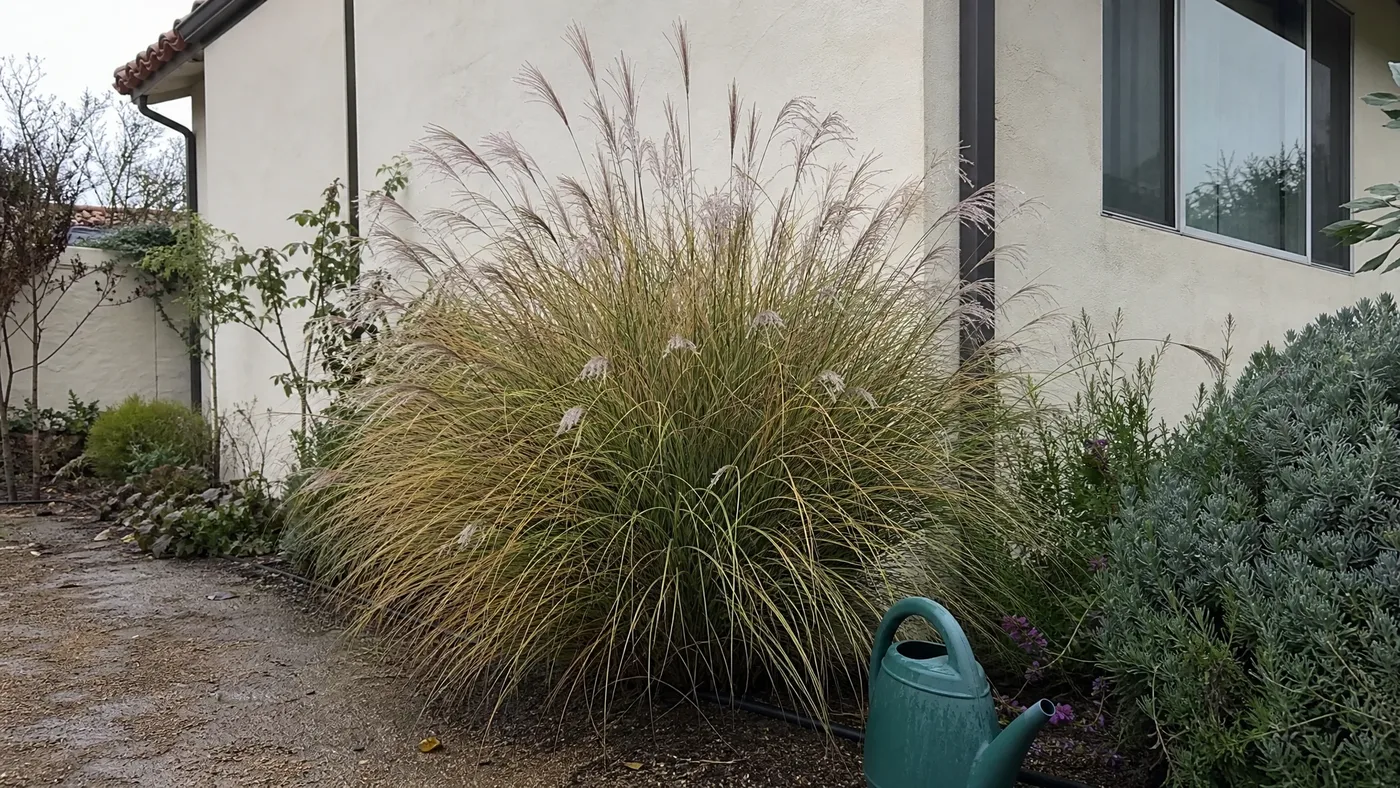
What Does Dwarf Maiden Grass Look Like?
Hold one blade of Dwarf Maiden Grass up to a window. It is about a quarter inch wide, with a pale silver midrib running down the center like a seam. Most people judge this plant by its plumes, but plumes show for only a few months. The blade is on the plant from spring to winter.
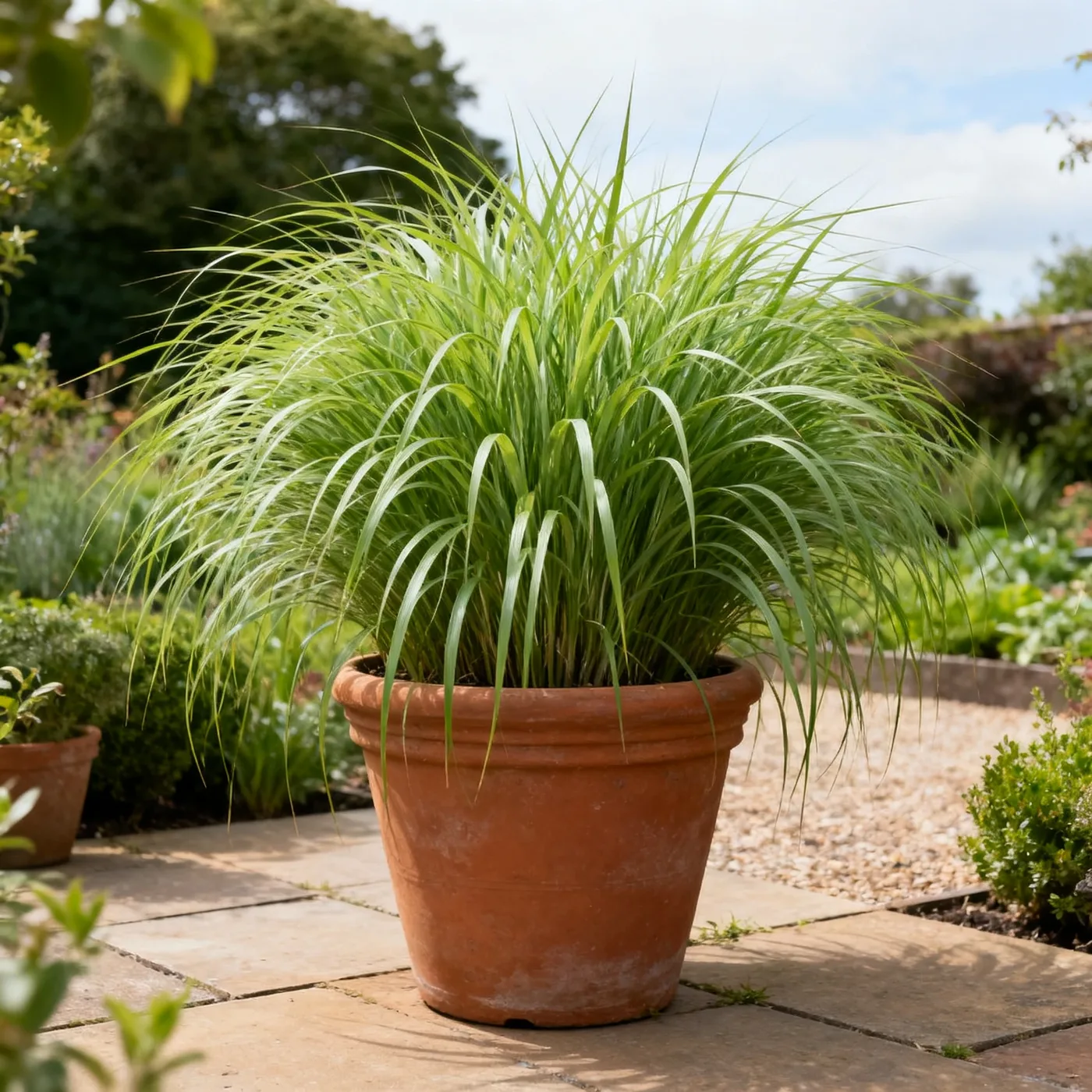
Misreading the look costs you. Buy a broad-bladed maiden grass by mistake and you get a clump that can run 4 to 12 feet where you planned a low mound. Read it right and you get a fine-textured fountain that stays in scale with a border.
In this article, we'll go through the blade and its color, the mound and root crown beneath it, the plume cycle and plume height, and how to tell it from its lookalikes at the nursery.
Fine Blades Behind Dwarf Maiden Grass Color
Take a ruler to one blade. On Dwarf Maiden Grass it measures roughly 1/4 to 3/8 inch across, thin enough to look like a ribbon rather than a leaf. Across the species, blades run from 0.25 to 2 inches wide and 3 to 5 feet long. The dwarf sits at the narrow end of that width range, and its blades run much shorter because the whole clump is smaller.
Narrow width is the quickest identifier. A broad blade stands stiff, while a thin blade has little to hold itself up and bends outward. That bend is the reason this plant forms a fountain, and the next section picks it up.
Why the Tone Reads Blue-Green
The foliage of 'Adagio' is gray-green, and an arboretum profile calls it silvery-gray. In our rows, we say blue-green. The cool tone comes from the blade surface, not from extra pigment. Grass leaves often carry a thin, pale, waxy coating that reflects part of the light, and that pulls the green toward gray or blue.
The midrib shows the same effect. It is the central rib that stiffens the blade, and it is paler than the tissue around it. Against the light it reads as a silver line. In autumn the blades turn orange and yellow.
Length, Veins and Feel
Run your eye along a blade from base to tip. Grass leaves carry long parallel veins, so a Miscanthus blade is a straight strip with no branching pattern, tapering to a fine point. Each blade grows from its base, which is why a blade chewed or snapped at the tip keeps growing from the bottom rather than dying back.
Run a finger along the edge and it feels slightly rough. That edge is one more clue that you are holding a Miscanthus and not a soft-leaved grass. Because the blades are so thin, a whole clump moves in even a light breeze, which is part of why people plant it where they can watch it.
How Dwarf Maiden Grass Builds Its Mound
Look at a plant in June, before any plume appears, and you see a low green fountain. Blades leave the center of the clump, rise, and tip outward. A fibrous crown at the soil line sends up new shoots each year, and each blade grows from its base. Stack enough arching blades around one crown and the outline becomes a dome.
The dome is compact. Before bloom, the foliage mound runs 18 to 30 inches tall. The habit is bushy and clump-forming, with a spread of 0.5 to 1 meter, about 1.5 to 3 feet. Height and width are close to equal, which is why the shape reads as round rather than upright. Our guide to mature size covers how those numbers settle over the years.
Arch Versus Upright
Standard maiden grass stands taller and more upright, with broad blades held on stiff stems. The dwarf bends sooner because its blades are thin, so the tips hang toward the ground and the clump looks soft from every side.
You will hear that dwarf grasses stay under two feet. This one does not. The mound can reach 30 inches, and the plumes ride above that.
The Mound Through the Year
In spring a new clump starts as short fresh blades pushing up through last year's tan stubble. By early summer the blades have filled out into the full dome. In autumn the foliage turns orange and yellow and then fades to straw through winter. The Arkansas Extension advice for maiden grass is to cut the plants to the ground in late winter, which clears the old mound so the new one can form clean.
Roots and Crown Set the Clump's Shape
Tip a clump out of its pot and the roots are the surprise. You find a mat of fine, fibrous roots packed tight around a hard crown, with no long runners reaching out. That packing sets the clump's shape. New shoots come up at the edge of the crown, right beside the old ones, so the plant widens in small steps instead of marching across the bed.
The Crown at the Soil Line
At the soil line the crown looks like a dense collar of shoot bases. Every shoot carries its own set of arching blades, so more shoots mean a fuller mound. A healthy nursery plant shows many shoots crowded together and roots reaching the edge of the pot.
The crown also stores the plant's reserves through winter. That is why the top can be cut to the ground each year and the clump still returns in spring. Keep the crown at the same depth it sat in the pot, because a buried crown rots and an exposed one dries out.
Why the Clump Widens Slowly
The species is a medium grower, and the dwarf spends less on each shoot than its tall relatives do. A new plant reaches its 1.5 to 3 foot spread over several seasons, not one. In our rows, a clump lifted after a few years comes up as one tight block of roots, and we cut it with a sharp spade rather than pull it apart.
Over many years the center of an old clump can open up. That is the cue to divide it, not a sign that something is wrong. Our guide to dividing the clump walks through the cut.
What the Roots Tell You About Water
A dense fibrous root mat holds a lot of fine root surface in a small footprint. Once it is established, that mat is why Arkansas Extension calls maiden grass extremely drought tolerant. A freshly planted clump has not built that mat yet, so it needs steady water in its first season. The crown shape and the root mat are both visible signs of how settled a plant is.
Why Dwarf Maiden Grass Plumes Change Hue
Photograph one plume in August and again in November and you would swear they came from two plants. The August plume is coppery pink, tight and slightly reddish. The November plume is silvery white, loose and feathery. The flower heads are pink-tinged and tassel-like in summer and turn creamy-white in autumn, and an arboretum profile calls the plumes long-lasting.
The color follows the flower. While the tiny flowers are open, their colored parts show through and give the pink or copper cast. Once flowering ends, the seed heads dry and the silky hairs on them lengthen and spread, which scatters light and reads as silver or white. The plume does not fade so much as open up. The species' plume branches are finger-like racemes up to 8 inches long, and you can watch those fingers fan apart as the head ages.
The Stages in Order
Think of the plume in three stages. First it is a narrow, upright spike close to the stem. Then the branches loosen and the copper-pink color peaks. Finally the seed head dries, the hairs fluff out, and the plume turns silver and then near white. Each stage lasts for weeks, which is why a single clump can show two shades at once when its plumes open on different days.
When the Color Starts
This cultivar starts early. 'Adagio' flowers consistently through August, and K-State ranked it as one of the earlier blooming Miscanthus in its trial. The species as a whole waits until late September in Arkansas. Your own timing shifts with climate, so check with your local extension service. The full color timeline is in our bloom time guide.
Measuring Plume Height Against the Foliage
Stand beside a clump in September and the plumes are the first thing you see, because they ride above the blades instead of tangling through them. An arboretum profile calls them high-held. 'Adagio' stands up to about 4 feet tall. With the mound at 18 to 30 inches, that puts the plume tips roughly 1.5 to 2.5 feet above the foliage.
The figures side by side:
| Measure | Typical figure |
|---|---|
| Foliage mound before bloom | 18–30 inches |
| Top height with plumes | about 4 feet |
| Plume tips above the mound | roughly 18–30 inches |
| Spread | about 1.5–3 feet |
When the Plumes Rise
The plume stems grow up from the middle of the mound through summer. In July they may still be hidden or just peeking out. By August, on an early bloomer like this one, they stand clear and keep their height into winter. Wind and heavy rain can bend them, but the stems are thin and springy, so they usually lift back up.
The plume adds height, not width. The footprint stays the 1.5 to 3 feet of the mound, which is why the plant suits a narrow border where a full-size maiden grass would crowd the path.
Reading the Tag
One of the most common questions we get is whether the plumes count in the listed height. Check the tag, because some list the mound and some list the plumes. If a tag gives a figure near 4 feet, it almost certainly counts the plumes. If it gives 2 to 2.5 feet, it is describing the foliage alone.
Dwarf Maiden Grass Features That Help You Spot It
In early spring a nursery pot holds stubble or a few new blades and no plumes at all, so a plume photo on the tag tells you little. Check the plant itself. Five features settle it:
- Blade width: hold a blade against a ruler. About 1/4 to 3/8 inch is right, and anything near an inch belongs to a larger maiden grass.
- Color and midrib: the blades are gray-green to blue-green, with a pale silver midrib you can see from a foot away.
- Habit: blades arch outward from the center into a rounded dome, not a vase of stiff upright stems.
- Crown: look for many shoots clustered tightly at the soil line, with no long runners, and roots showing at the pot's edge.
- Tag clues: look for a cultivar name, most often 'Adagio' or 'Yaku Jima', and a mature height near 4 feet. A tag listing a much taller height points to a larger selection.
A plant sold without a cultivar name is a risk. Dwarf and full-size maiden grass look alike in a small pot, and the difference only shows two seasons later. If a seller cannot tell you the cultivar, measure the blades and walk away if they are wider than half an inch. For what each pot size gets you, see our guide to container sizes.
Telling It Apart From Similar Grasses
Two plants get mistaken for this one most often: the full-size maiden grass it was bred down from, and fountain grass. Size, blade width and plume shape separate them.
| Trait | Dwarf maiden grass | Larger maiden grass | Fountain grass |
|---|---|---|---|
| Height | about 4 feet with plumes | 4–12 feet | low to medium mound |
| Blade width | 1/4–3/8 inch | up to 2 inches | fine and narrow |
| Habit | rounded dome | taller, more upright | arching fountain |
| Plume | open, finger-like branches | open, finger-like branches | dense, fuzzy bottlebrush |
Against Larger Maiden Grass
The species runs 4 to 12 feet tall, and its blades can reach 2 inches wide, more than five times the dwarf's width. The silhouette is taller and more upright. The dwarf selections are shorter in every way. 'Yaku Jima' is a dwarf form with low seed set, and our comparison of Adagio and Yaku Jima sets the two side by side.
Against Fountain Grass
Fountain grass also arches and also has fine blades, so blade width alone will not settle it. Look at the plume. Fountain grass carries dense, fuzzy bottlebrush spikes. Dwarf maiden grass carries open plumes of finger-like branches that fan apart as they dry. Our fountain grass comparison goes into the growing differences.
Picture the Plant Before You Pay
Keep a short set of numbers in your head. A blade 1/4 to 3/8 inch wide with a silver midrib. A gray-green mound 18 to 30 inches tall and about 1.5 to 3 feet across. Coppery pink plumes from August that turn silvery white and stand up to about 4 feet in total. If the numbers are far off, you are looking at a different grass.
In a pot, it is a tight fountain of thin gray-green blades on a dense crown, so check blade width and crown size before you buy.
Dwarf Maiden Grass
Nursery-grown Dwarf Maiden Grass in sizes from Quart, shipped to your door.
From $19.99
Shop Now →Dwarf Maiden Grass settles into our farm rows with sun overhead from morning to evening and loose ground that lets rain drain right through. Our own growers raise and pack every top-quality grass we sell, so the fine-bladed mound you have just read about comes from hands that know it well. When you are ready to plant one, pick out a Dwarf Maiden Grass for your garden.